

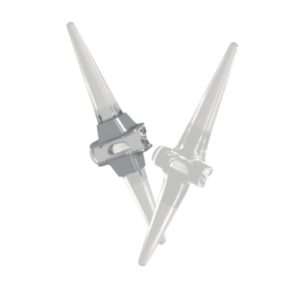
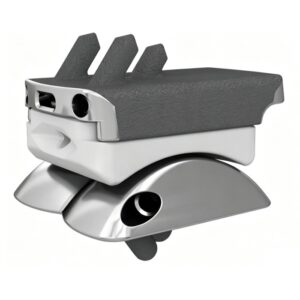
Fracture fixation is a fundamental part of orthopedic trauma care, helping restore bone alignment, maintain fracture stability, and create favorable conditions for bone healing. Among the various fracture fixation methods available today, plate fixation is widely used to treat fractures across different anatomical regions. Within modern plate fixation, locking plates have become an important solution for managing a wide range of fracture patterns.
So, what are locking plates? A locking plate is an orthopedic implant that uses locking screws to engage directly with threaded holes in the plate, creating a fixed-angle screw-plate construct. Unlike conventional plates, which primarily rely on friction and compression between the plate and bone, locking plate fixation provides angular stability and can reduce the dependence on plate-to-bone contact. These characteristics make locking plates particularly useful in selected complex, comminuted, metaphyseal, periarticular, and osteoporotic fractures.
Understanding how locking plates work, the different types of locking plates available, and their clinical applications can help orthopedic professionals better evaluate fracture fixation options. In this guide, we explore the principles of locking plate fixation, the main types of locking plates, their advantages and applications, and key factors to consider when selecting a locking plate system for fracture treatment.
What Is a Locking Plate?
A locking plate is an orthopedic implant designed to stabilize fractured bone using locking screws that engage directly with threaded holes in the plate.
In a conventional plate fixation construct, the screw head presses the plate against the bone. Stability therefore depends significantly on the friction created between the plate and the underlying bone.
With a locking plate, the screw head locks into the threaded plate hole. The screw and plate therefore function as a fixed-angle construct rather than relying primarily on plate-to-bone compression.
This design can be particularly useful when stable fixation is required in complex fractures, metaphyseal regions, periarticular fractures, or bone with reduced quality.
How Do Locking Plates Work?
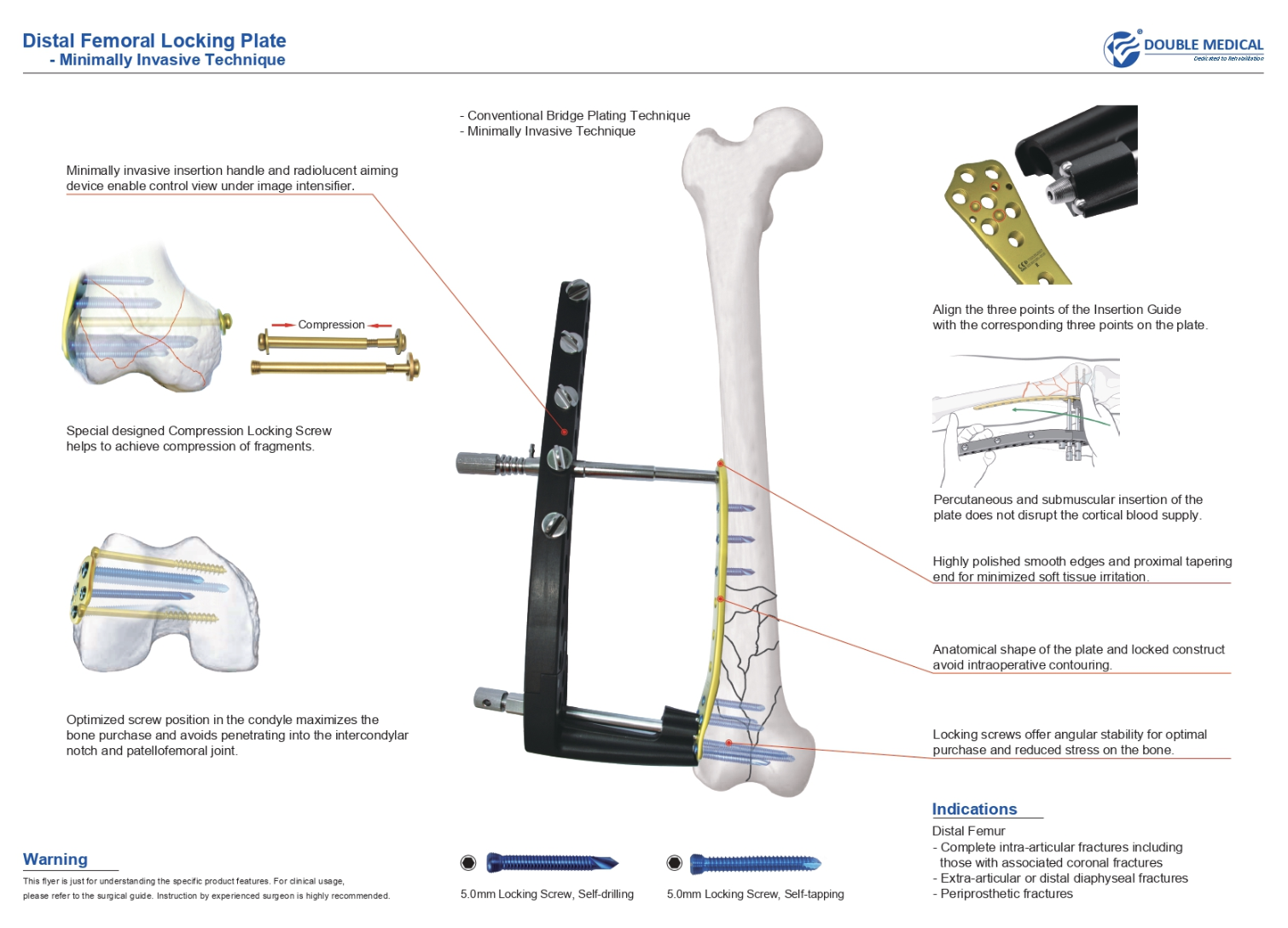
The basic working principle of a locking plate involves several components:
- Threaded plate holes: The plate contains specially designed holes that allow compatible locking screws to engage with the plate.
- Locking screw engagement: The screw head locks into the threaded hole, creating a fixed relationship between the screw and plate.
- Fixed-angle stability: Once locked, the screw is less dependent on friction between the plate and bone to maintain its position.
- Load distribution: Multiple screws can work together to distribute mechanical forces throughout the fixation construct.
- Fracture stabilization: Depending on the fracture pattern and surgical technique, the plate can function as a compression or bridging construct.
Because of these characteristics, locking plates can provide useful fixation options across a wide range of fracture patterns.
Types of Locking Plates
Locking plates are available in different configurations and anatomical designs to address specific fracture patterns and surgical requirements.
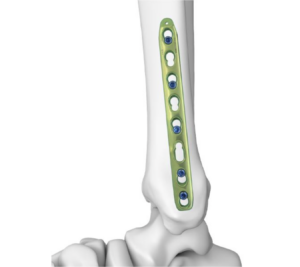
- Anatomical Locking Plates 2. Metaphyseal Locking Plates
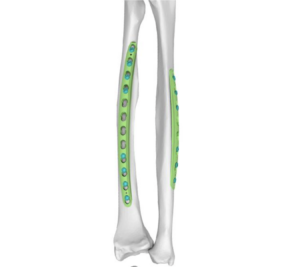
Anatomical Locking Plates
Anatomical locking plates are shaped to correspond more closely to the anatomy of a particular bone or region.
Their precontoured geometry can help facilitate positioning and fixation around anatomically complex areas, particularly near joints.
Depending on the anatomical location, locking plates may be designed for areas such as the femur, tibia, humerus, radius, clavicle, and other bones.
Compression Locking Plates
Some locking plate systems combine locking screw holes with options for conventional compression.
This allows surgeons to select different fixation strategies according to the fracture pattern and surgical objectives. For example, compression may be useful for selected simple fracture patterns, while locking fixation can provide angular stability where needed.
Metaphyseal and Periarticular Locking Plates
Fractures near joints can present particular fixation challenges because of limited bone stock, complex anatomy, and the need to maintain joint alignment.
Metaphyseal and periarticular locking plates are designed to address these challenges through anatomical contours and strategically positioned screw holes.
These systems may be particularly useful for fractures involving the distal femur, proximal tibia, distal tibia, and other periarticular regions.
Advantages of Locking Plates in Fracture Fixation
- Angular Stability
One of the key characteristics of locking plates is the fixed-angle relationship between the screw and plate.
This can help maintain screw orientation and provide a stable construct, which is particularly valuable in areas where conventional screw purchase may be challenging.
- Reduced Dependence on Plate-to-Bone Compression
Because locking screws engage directly with the plate, fixation does not rely to the same extent on pressing the plate tightly against the bone.
This allows locking plates to be used with fixation strategies that minimize unnecessary disruption around the fracture site.
- Useful in Poor Bone Quality
Bone quality can significantly influence fracture fixation.
In osteoporotic or otherwise compromised bone, conventional screws may have reduced purchase. A locking construct can provide an alternative fixation strategy by creating a stable screw-plate relationship.
However, the appropriate fixation method should always be determined according to the patient’s bone quality, fracture characteristics, and surgical requirements.
- Suitable for Complex Fractures
Locking plates are commonly used in fracture patterns where maintaining alignment and stability can be challenging, including:
- Comminuted fractures
- Metaphyseal fractures
- Periarticular fractures
- Multifragments
- Certain osteoporotic fractures
Their ability to function as a fixed-angle construct can make them useful for bridge plating and other fixation strategies.
- Compatibility with Minimally Invasive Fixation Techniques
Locking plate systems can also be used with minimally invasive plate osteosynthesis (MIPO) techniques when appropriate.
In these situations, the plate may function as a bridge across the fracture zone while maintaining alignment and providing fixation through strategically positioned screws.
Locking Plates vs Non-Locking Plates
Locking Plates vs Non-Locking Plate
Locking plates and non-locking plates differ primarily in how the screw interacts with the plate and how stability is achieved within the fixation construct.
| Feature | Locking Plates | Conventional Plates |
| Screw-plate connection | Screw locks into plate | Screw presses plate against bone |
| Angular stability | Provided by fixed-angle construct | More dependent on screw and plate-bone interaction |
| Plate-bone compression | Less dependent | More important |
| Complex fractures | Often well suited | Depends on fracture patten |
| Periarticular fractures | Particularly useful | Case dependent |
| Poor bone quality | Can provide useful fixation options | More dependent on bone purchase |
| Minimally invasive technology | Compatible | Also, possible |
| Fixation strategy | Locking, bridging or combined techniques | Primarily compression/ friction-based |
Neither locking nor conventional plates are universally superior. The appropriate choice depends on the fracture pattern, anatomical location, bone quality, and desired fixation strategy.
Limitations and Considerations of Locking Plates
- Locking plates are not universally superior
- Appropriate screw configuration is important
- Excessive stiffness may not always be desirable
- Implant selection depends on fracture pattern
- Surgical technique remains important
- Cost/implant complexity may be considerations
When Are Locking Plates Used?
- Osteoporotic Fractures
Reduced bone density can make conventional screw fixation more challenging. Locking constructs can provide an alternative approach to maintaining fixation in selected osteoporotic fractures.
- Comminuted and Multifragamentary Fractures
When a fracture contains multiple fragments, direct compression across every fragment may not be appropriate.
A locking plate can be used as a bridging construct, helping maintain overall alignment while limiting the need for extensive manipulation of individual fracture fragments.
- Metaphyseal Fractures
Metaphyseal regions can have complex geometry and varying bone quality.
Anatomical locking plates can provide fixed-angle fixation in these areas while accommodating different screw trajectories and configurations.
- Periarticular Fractures
Fractures close to joints often require careful restoration of alignment and stable fixation.
Locking plates designed for periarticular anatomy can provide multiple points of fixation around the affected region.
- Minimally Invasive Fracture Fixation
When a minimally invasive approach is appropriate, locking plates can be used as part of a bridge-plating strategy.
The specific surgical technique should be selected based on fracture characteristics and the surgeon’s clinical judgment.
How to Choose the Right Locking Plate?
Selecting a locking plate is not simply a matter of choosing the strongest implant. Several factors should be considered.
- Anatomical Location
The plate should correspond to the anatomical region being treated. Anatomical contours and available screw trajectories can influence implant selection.
- Fracture Pattern
Simple, comminuted, metaphyseal, and periarticular fractures may require different fixation strategies.
- Bone Quality
Bone density and local bone stock should be considered when determining the appropriate screw configuration and fixation method.
- Plate Length and Screw Configuration
The appropriate plate length and number and configuration of screws depend on the fracture pattern and surgical strategy.
- Surgical Approach
The selected implant should be compatible with the intended surgical approach, including open or minimally invasive techniques when applicable.
- Instrumentation
A complete locking plate system should be supported by appropriate instrumentation to facilitate plate positioning, drilling, screw insertion, and intraoperative workflow.
Double Medical Locking Plate Solutions
As an orthopedic implant manufacturer, Double Medical provides trauma fixation solutions designed for different anatomical regions and fracture patterns.
Our locking plate portfolio includes anatomical solutions for complex fractures involving the lower extremities and periarticular regions.
Distal Femoral Locking Plate
Distal femur fractures can involve complex fracture patterns and may extend toward the knee joint. A dedicated distal femoral locking plate is designed to provide anatomical fixation around the distal femur while accommodating locking screw.
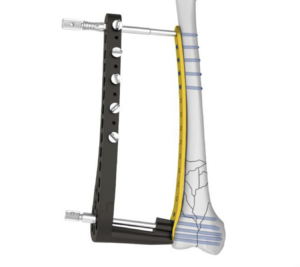
Distal Femoral Locking Plate II
Proximal Tibial Locking Plate
Proximal tibial fractures can present challenges because of their proximity to the knee joint and the complex anatomy of the proximal tibia.
A proximal tibial locking plate provides an anatomical fixation option designed for fracture stabilization in this region.
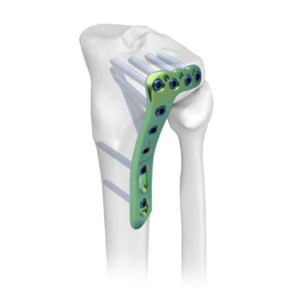 Proximal Lateral Tibial Locking Plate II
Distal Tibial Locking Plate
Distal tibial fractures occur close to the ankle and can involve limited soft-tissue coverage and complex fracture patterns.
A dedicated distal tibial locking plate provides an anatomical option for fixation around the distal tibia and ankle region.
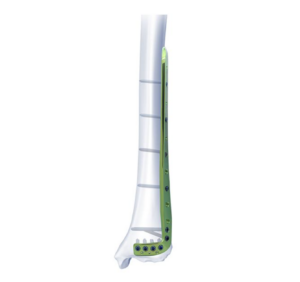
Distal Lateral Tibial Locking Plate
Together, these solutions demonstrate how anatomical locking plate systems can be designed around the specific requirements of different fracture locations.
Conclusion
Locking plates have become an important option in modern fracture fixation because they combine anatomical implant design with fixed-angle screw-plate fixation.
Their advantages include angular stability, reduced dependence on plate-to-bone compression, versatility in complex fractures, and compatibility with a range of fixation strategies. They can be particularly useful for selected metaphyseal, periarticular, comminuted, and osteoporotic fractures.
However, no single fixation system is appropriate for every fracture. The choice between locking and conventional plates should be based on fracture pattern, anatomical location, bone quality, surgical approach, and the overall treatment objective.
With a broad trauma portfolio and anatomical fixation solutions, Double Medical supports orthopedic professionals and partners with implant options designed for diverse fracture fixation requirements.
Explore Double Medical’s Trauma Solutions or contact our team to learn more about our orthopedic implant portfolio.
FAQ
- What is a locking plate used for?
Locking plates are used to stabilize fractured bones. They can be particularly useful for complex, metaphyseal, periarticular, and selected osteoporotic fractures where angular stability is important.
- Are locking plates better than conventional plates?
Not necessarily. Locking and conventional plates have different mechanical principles and applications. Implant selection should consider the fracture pattern, bone quality, anatomy, and surgical objectives.
- What makes a locking plate different from a regular plate?
The key difference is the connection between the screw and plate. Locking screws engage with threaded plate holes to create a fixed-angle construct, while conventional screws primarily secure the plate through compression and friction between the plate and bone.
- Can locking plates be used for minimally invasive surgery?
Yes. Locking plates can be incorporated into minimally invasive plate osteosynthesis (MIPO) techniques when clinically appropriate.
- Are locking plates suitable for osteoporotic bone?
Locking plates can provide useful fixation options in selected fractures involving poor bone quality because the screw-plate construct is less dependent on conventional plate-to-bone compression. However, implant selection should be individualized according to the patient’s condition and fracture characteristics.